
.png?width=4480&height=2520&name=5%20EMC%20Troubleshooting%20Books%20(1).png)
Electromagnetic compatibility is one of those engineering disciplines where hands-on experience matters enormously but so does having the right reference material when you need it.
Whether you're investigating an emissions issue, trying to understand why a filter isn't performing as expected, or simply want to deepen your understanding of EMC principles, the right books can accelerate your learning and provide valuable perspectives from engineers who've tackled similar challenges.
This guide presents five EMC books specifically focused on troubleshooting and practical diagnostics resources that complement foundational EMC texts with hands-on, problem-solving approaches. These are the books that experienced EMC engineers keep within arm's reach.
Why Troubleshooting-Focused Resources Matter
Most EMC education focuses on design principles: how to lay out PCBs, select components, and implement shielding and filtering from the start. That knowledge is essential.
But real-world engineering rarely follows the textbook path. Products inherit legacy designs. Schedule pressures force compromises. Unexpected interactions emerge during integration. And sometimes, despite best efforts, EMC issues appear that weren't anticipated.
When that happens, you need a different kind of resource—one focused on diagnosis, investigation, and practical problem-solving rather than ideal-world design principles.
The books in this guide address that need. They're written by engineers who've spent careers investigating EMC problems, and they share the systematic approaches and practical techniques that make troubleshooting more effective.
5 Recommended EMC Troubleshooting Books
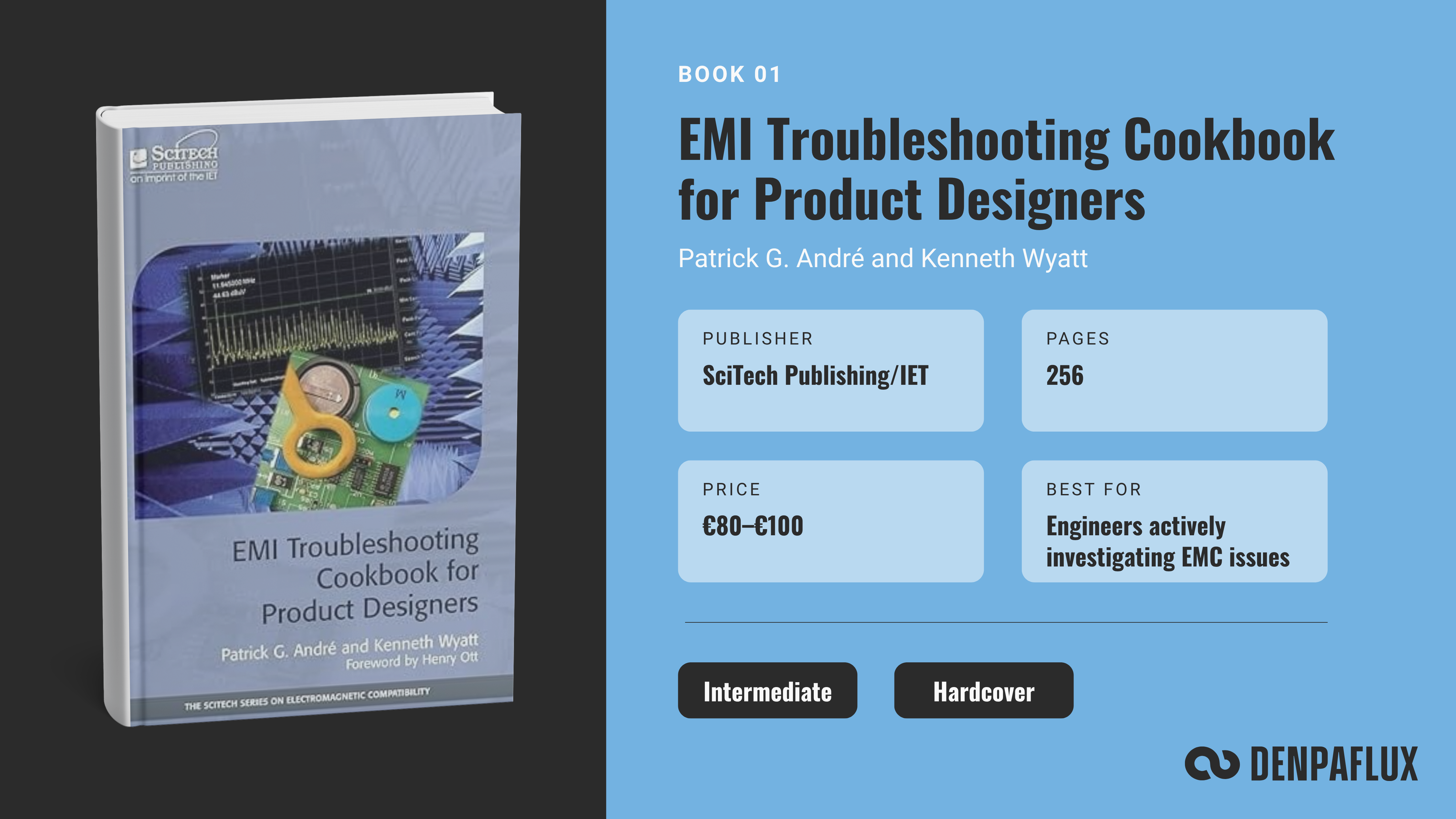
1. EMI Troubleshooting Cookbook for Product Designers
A Systematic Approach to EMC Diagnosis
Why This Book?
With a foreword by Henry Ott, this book brings together decades of practical troubleshooting experience. Patrick André spent over 30 years in military and aerospace EMC work, while Kenneth Wyatt accumulated 20+ years of experience at Hewlett-Packard and Agilent Technologies.
The "cookbook" format organizes content around specific problem types rather than theoretical categories. Need to investigate radiated emissions? There's a dedicated chapter. Conducted emissions? ESD? Immunity issues? Each gets focused treatment with a consistent structure—making it genuinely useful as a working reference during active investigations.
Key Topics Covered
- Radiated emissions investigation and near-field probing techniques
- Conducted emissions diagnosis (common-mode vs. differential-mode)
- ESD susceptibility identification and coupling path analysis
- Immunity test failure investigation
- Building inexpensive DIY diagnostic tools
- Spectrum analyzer and current probe applications
- Systematic approaches to narrowing down problem areas
Who Should Read This?
Hardware engineers who need to investigate EMC issues, whether as a primary responsibility or occasional task. Particularly valuable for product engineers, test engineers, and consultants who troubleshoot across different product types.
2. EMC Question of the Week: 2021–2024
Building EMC Intuition Through Active Learning
.png)
Why This Book?
Dr. Todd Hubing brings exceptional credentials: IEEE Fellow, Past-President of the IEEE Electromagnetic Compatibility Society, and decades of experience spanning IBM, academia, and consulting. His ability to explain complex concepts clearly has made him one of the most respected EMC educators in the field.
The Q&A format mirrors real-world troubleshooting—constantly asking why is this happening? and what could cause this symptom? Each question includes detailed explanations that reveal not just the correct answer, but why common misconceptions fail. This helps engineers identify knowledge gaps they didn't know they had.
Key Topics Covered
- Physical mechanisms of electromagnetic coupling
- PCB layout principles for EMC
- Grounding strategies and common pitfalls
- Cable shielding and termination techniques
- Filter design and component selection
- Common-mode vs. differential-mode issues
- Shielding effectiveness factors
- High-speed interface challenges
Who Should Read This?
Engineers preparing for iNARTE certification, teams wanting structured EMC training material, experienced engineers seeking to refresh knowledge, and self-directed learners who engage better with interactive question-based formats.
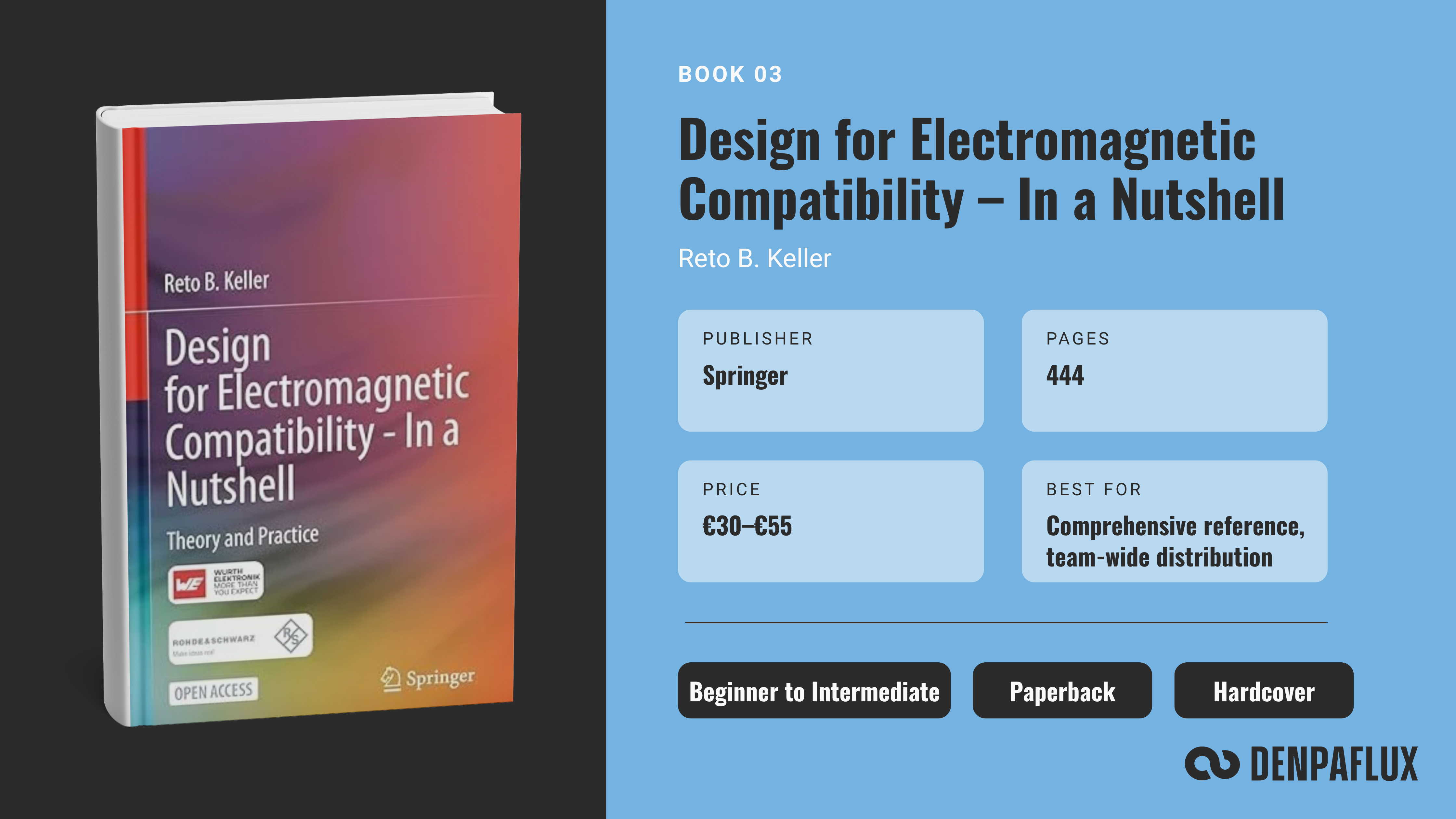
3. Design for Electromagnetic Compatibility—In a Nutshell
Modern EMC Knowledge—Freely Available
Why This Book?
Reto Keller brings 15+ years of product development experience at Roche Diagnostics, combined with his role as president of the Academy of EMC. Published under Springer's open access program, teams can legally download and share the PDF with all members—making it practical for organization-wide reference.
This is one of the most up-to-date comprehensive EMC texts available, referencing current standards and addressing contemporary design challenges. Keller writes clearly, explaining concepts without unnecessary mathematical complexity while maintaining technical accuracy.
Key Topics Covered
- Component behavior at high frequencies (capacitors, inductors, ferrites)
- Filter design principles and component selection
- Grounding strategies and ground loop prevention
- Shielding fundamentals (apertures, seams, cable penetrations)
- EMC test methods overview (radiated emissions, immunity, ESD)
- Current EMC standards and regulatory requirements
- Practical design guidelines for common scenarios
Who Should Read This?
Engineers wanting a modern, comprehensive EMC reference. Teams needing to distribute quality EMC material cost-effectively. Budget-conscious organizations, startups, and anyone who prefers searchable PDF reference materials.
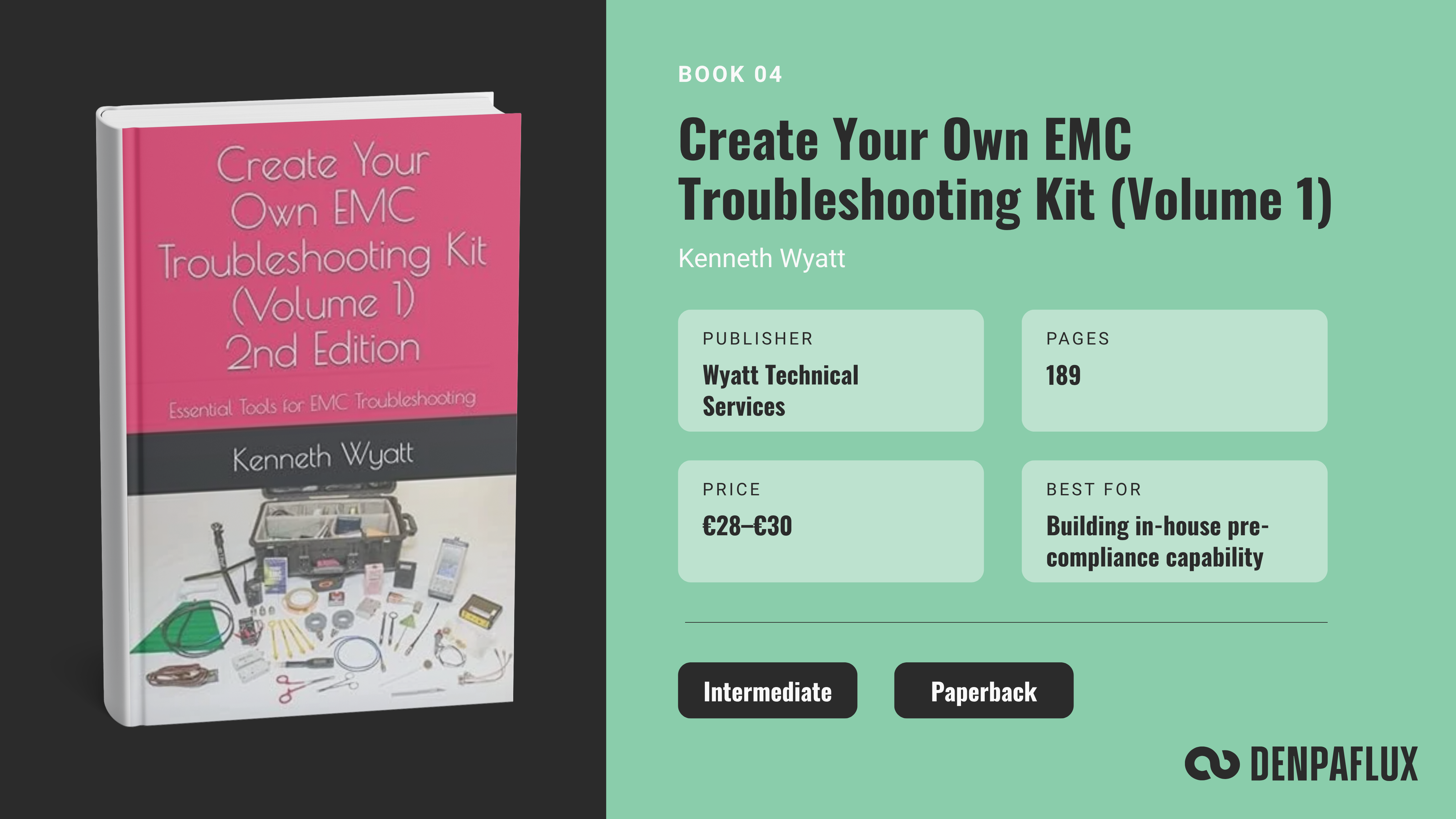
4. Create Your Own EMC Troubleshooting Kit (Volume 1)
Building Practical Diagnostic Capability on a Budget
Why This Book?
Kenneth Wyatt's extensive EMC experience—including his years at HP/Agilent and subsequent consulting work—informs this practical guide to assembling effective EMC diagnostic tools without massive capital investment.
Many engineering teams lack access to dedicated EMC test facilities. When EMC questions arise during development, they face a choice: wait for expensive external lab time, or work without adequate diagnostic tools. Wyatt offers a third path: build practical diagnostic capability using a combination of affordable commercial equipment and DIY tools.
What makes this book trustworthy is Wyatt's transparency about what DIY approaches can and cannot achieve compared to calibrated test facilities.
Key Topics Covered
- Building effective near-field probes (H-field and E-field)
- Current probe selection and applications
- Spectrum analyzer features relevant to EMC work
- LISN options across price points
- Improvised antennas and their limitations
- Pre-compliance measurement techniques
- Honest assessment of DIY tool capabilities
Who Should Read This?
Engineers at organizations without dedicated EMC test facilities. Teams building pre-compliance diagnostic capability. Consultants assembling portable troubleshooting kits. Budget-conscious engineering organizations looking to catch issues early in development.
Note: This is Volume 1 of a three-part series. Volume 2 covers emissions troubleshooting, Volume 3 covers immunity troubleshooting.
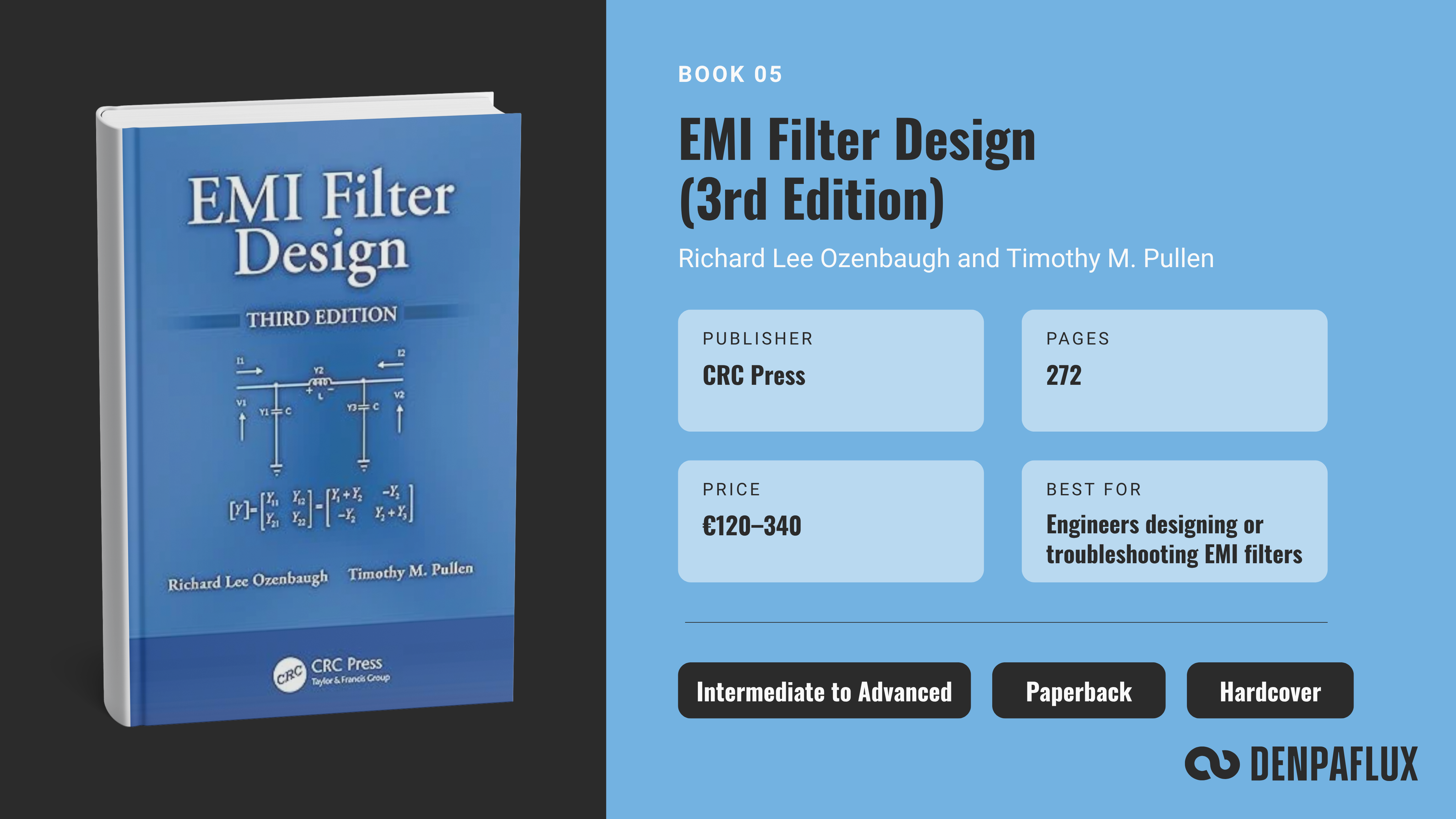
5. EMI Filter Design (3rd Edition)
The Specialist Guide for Filter Challenges
Why This Book?
Many EMC investigations conclude with "we need a filter" or "the existing filter isn't working." When that happens, general EMC knowledge often isn't enough—filter design has nuances that determine success or failure.
This specialist reference addresses filter design in depth that general EMC texts can't match. It covers why filters fail in practice (self-resonance, saturation, layout-induced coupling, impedance mismatches) and how to design filters that actually work in real circuits—not just on paper.
Key Topics Covered
- Common-mode vs. differential-mode filter design
- Component selection (capacitors, inductors, ferrites) for filter applications
- High-frequency considerations (lead inductance, ESL, PCB layout)
- Self-resonance and saturation effects
- Source and load impedance considerations
- Application-specific requirements:
- Aviation systems (400Hz)
- Military standards (MIL-STD-461)
- Medical devices (leakage current)
- Automotive applications
Who Should Read This?
Power electronics engineers addressing conducted emissions. Engineers designing products for regulated industries (aerospace, medical, military). Anyone whose standard filter approaches haven't solved the problem. Specialists responsible for EMC filter specifications.
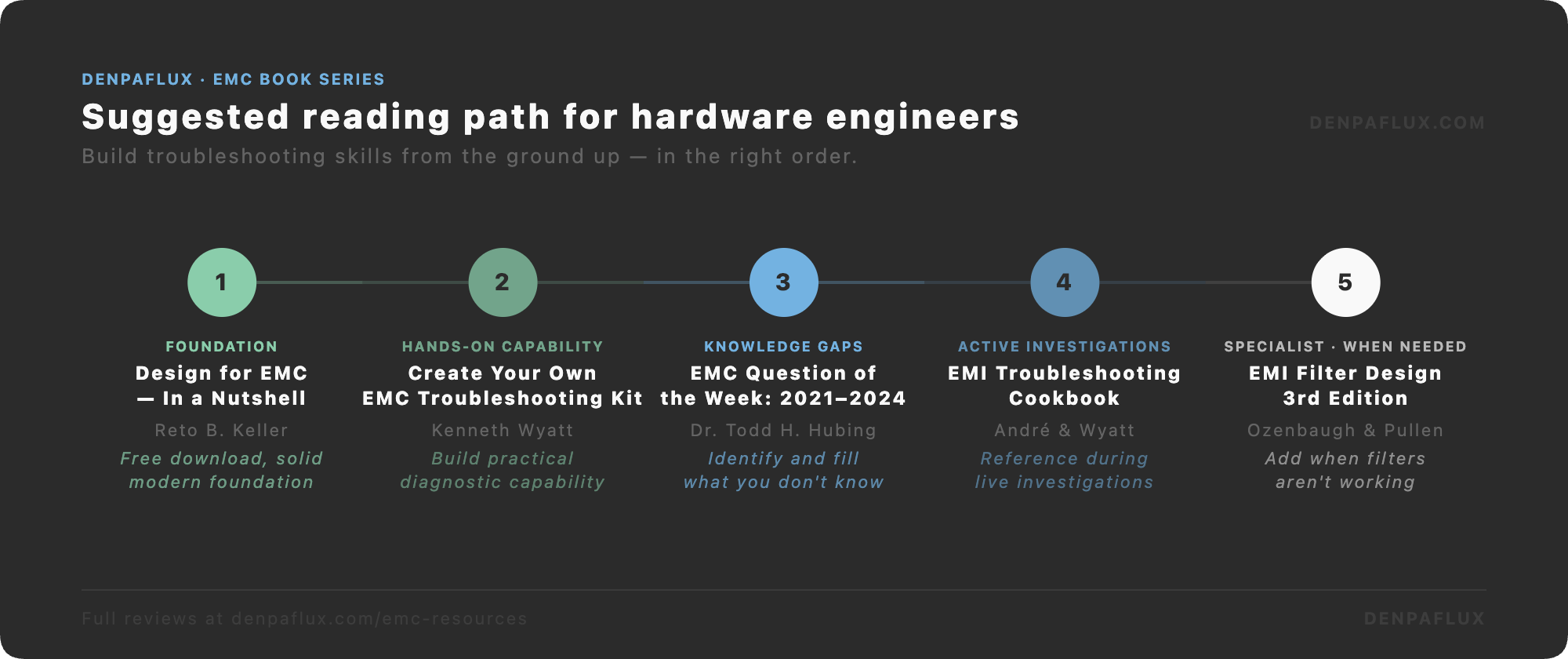
Quick Comparison: Which Book Is Right for You?
| Situation | Recommended Book | Level |
|---|---|---|
| Actively investigating an EMC issue | EMI Troubleshooting Cookbook | Intermediate |
| Want structured learning or certification prep | EMC Question of the Week | All levels |
| Need comprehensive reference (FREE) | Design for EMC—In a Nutshell | Beginner–Intermediate |
| Building pre-compliance diagnostic capability | Create Your Own EMC Troubleshooting Kit | Intermediate |
| Designing or troubleshooting filters | EMI Filter Design | Intermediate–Advanced |
Strengthen Your Team's EMC Capabilities
Books provide essential knowledge, but some EMC challenges benefit from experienced guidance. Complex investigations, tight timelines, and specialized requirements sometimes call for additional support.
At DENPAFLUX, our EMC engineers work with hardware teams across industries, offering:
- Pre-compliance testing to identify issues early in development
- Troubleshooting support for challenging EMC investigations
- Design reviews focused on EMC considerations
- Training tailored to your team's needs and products
Frequently Asked Questions
.webp?width=352&name=5%20Best%20EMC%20Books%20to%20read%20in%202023%20(Recommended%20by%20EMC%20Experts).webp)